Review of Stories for Boys for The Live Review, June 2026
"DEATH IS ALWAYS DIMLY THERE, BUT IF WE FOCUS ON IT, LIFE NO LONGER MAKES SENSE."
A review by Charlotte Mason-Mottram
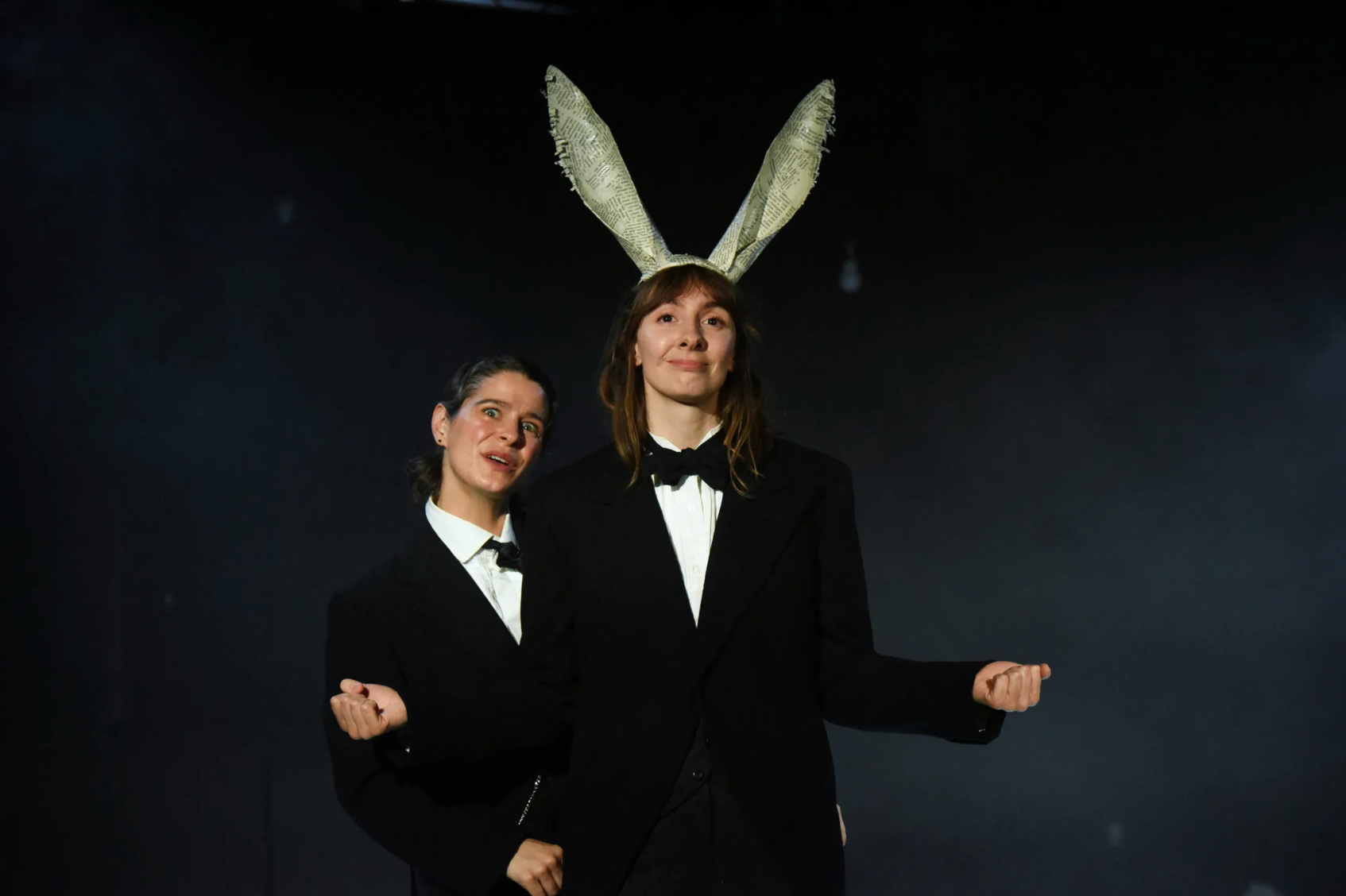
Stories for Boys, written by Kieron Barry and directed by Hope Wishart, begins with a deceptively simple question: what do we do about death? What follows is anything but simple. Staged at the intimate Drayton Arms Theatre, this wildly inventive production is aptly described by one of the cast members (Agatha Elwes) as a “kaleidoscopic piece of theatre” — it ricochets between philosophy lecture, sketch comedy, existential crisis, and physical theatre.
Despite drawing heavily on familiar territory (life, death, love, and art), the play feels remarkably original. In fact, originality may be its greatest achievement. Just when you think there are no new ways to discuss mortality or meaning, Stories for Boys twists language, perspective, and theatrical convention into something that feels entirely fresh. It is as though you are hearing the English language for the first time.
The cast members (Adam Barlow, Lewis Blomfield, Florence Dobson, Agatha Elwes, Samuel Ferrer, and Thelma Solea) are astonishingly agile, both physically and intellectually. Scenes flow seamlessly into one another, with transitions that feel as poetic as the works of art being referenced. At one point, Solea’s body becomes a landscape, her inclined hips transformed into a hill down which a miniature car travels. Elsewhere, performers contort themselves into elaborate positions while delivering some of the most complex and densely packed dialogue imaginable. It is a production that demands precision and stamina, and each cast member rises to the challenge effortlessly.
Oh, and the humour is relentless. I laughed out loud multiple times! One particularly memorable scene sees three colleagues discussing the death of a co-worker whilst participating in a yoga class. The juxtaposition is absurd and hilarious, highlighting the strange ways we attempt to process grief through the rituals of modern life. Throughout, the play finds comedy where most writers would find despair.
There are brilliant one-liners scattered throughout the script. When Basso (Agatha Elwes) attempts to understand her place in the afterlife, she concludes that she must be in limbo, which she describes as “a spiritual equivalent of New Malden.”
What makes Stories for Boys so compelling is its refusal to take itself too seriously, while still maximising effort and output. For a play preoccupied with death, it feels remarkably alive. It pokes fun at art, language, academia, and our endless need to analyse everything. It asks whether language itself is pretentious, whether our attempts to assign meaning are pointless, and whether any of it really matters when we are all heading towards the same destination.
Yet the play never feels cynical. Instead, it portrays something strangely comforting in our collective confusion. Like the best absurdist comedy, it acknowledges the terrifying vastness of existence whilst encouraging us to laugh at it anyway.
Fans of The Mighty Boosh will find plenty to enjoy here, but Stories for Boys is far more than a series of clever sketches. By the end, you may not have any answers. But you will almost certainly leave with a smile on your face.
Stories For Boys is running at Drayton Arms Theatre until Saturday 20 June.